




















Tow Truck Safety and Remote Control Compliance in Australia: Key Updates on AS5400 and AS1418 Standards
Blog • Posted on July 3, 2025 at 9:43 am
Published: July 2025
In Australia, the use of wireless remote control systems for tow trucks is subject to specific regulations to ensure safety, compliance, and operational efficiency. These regulations may vary slightly across states and territories, but they generally align with national standards set by bodies such as the Standards Australia and relevant road transport authorities.
Below is a detailed overview of the key regulatory considerations for wireless remotes used in tow trucks:
| AS5400-2015 Overview of Standards: Tow Trucks – Tilt Tray Vehicles – Design, Construction, and Safety Requirements | AS1418.1:2001 Overview of Standards: Cranes, Hoists and Winches General Requirements |
|---|---|
| Reference to 2.5.2 Hydraulic equipment and controls: | Reference to 8.7.3.4.2 System design requirements |
| Hydraulic equipment and controls shall comply with the relevant requirements of AS 1418.1 for hydraulic equipment and controls, except for the requirements to provide hydraulic circuit diagrams on every tow truck; and, where applicable, with specific requirements appropriate to particular types of tow trucks as set out in this Standard. | – Fail-Safe Design: The wireless control system for cranes/hoists and winches must be designed to be safe even if something goes wrong. The cranes/hoists and winches can only move when the controller is actively being used and is within range. If the cranes/hoists and winches are out of the controller’s range, all movements must stop automatically. |
| 2.5.3 Pneumatic equipment and controls | – Emergency Stop Safety: If there’s a problem with the transmitter or receiver, the cranes/hoists and winches can still be stopped safely using an emergency stop button or a key switch. |
| Pneumatic equipment and controls shall comply with the relevant requirements of AS 1418 .1 for pneumatic equipment and controls, except for the requirements to provide pneumatic circuit diagrams on every tow truck, and controls and, where applicable, with specific requirements appropriate to particular types of tow trucks as set out in this Standard. | – Automatic Shutdown Triggers: The main power to the cranes/hoists and winches will turn off if any of these happen: No valid signal is received for more than 550 milliseconds (about half a second).There’s interference from other devices or signals.The key switch is turned to the “off” position.The emergency stop is pressed.No movement is made for 5 minutes (unless this would make the cranes/hoists and winches unsafe to operate). |
| – Secure Signal System: The wireless controller’s signal must be unique, secure, and protected from interference or tampering.If multiple cranes/hoists and winches are in the same area, the system must prevent their signals from interfering with each other.Each controller must have its own unique code, but systems can be designed to allow safe handovers between multiple controllers or cranes/hoists and winches if needed. | |
| – One Controller at a Time: The system must ensure that only one control method (wireless or wired) can operate the cranes/hoists and winches at any time, keeping the safety features intact. | |
| – Low Battery Warning: If the controller uses a battery, it must give a warning (like a light or sound) at least 5 minutes before the battery runs too low to work.This gives the operator time to safely lower any load and stop the cranes/hoists and winches without creating an unsafe situation.A low battery should never cause the cranes/hoists and winches to act unsafely. | |
| – Safe Startup: The system must check that all controls for the cranes/hoists and winches are in the “off” position when starting up. If they aren’t, the cranes/hoists and winches won’t respond to commands until they are. | |
| – Protection from Interference: The system must be designed to ignore interference from things like arc welding or direct sunlight, ensuring no accidental movements of the cranes/hoists and winches. | |
| – Fast Emergency Stop: The emergency stop must work quickly, stopping the cranes/hoists and winches within 550 milliseconds (about half a second) when activated. | |
| – Multiple Machine Operation: If one wireless controller operates multiple cranes/hoists and winches, each machine must show a clear visual signal (like a light) to indicate which one is selected.The controller must have a way to test this signal to ensure it’s working properly. |
What Tele Radio® offers
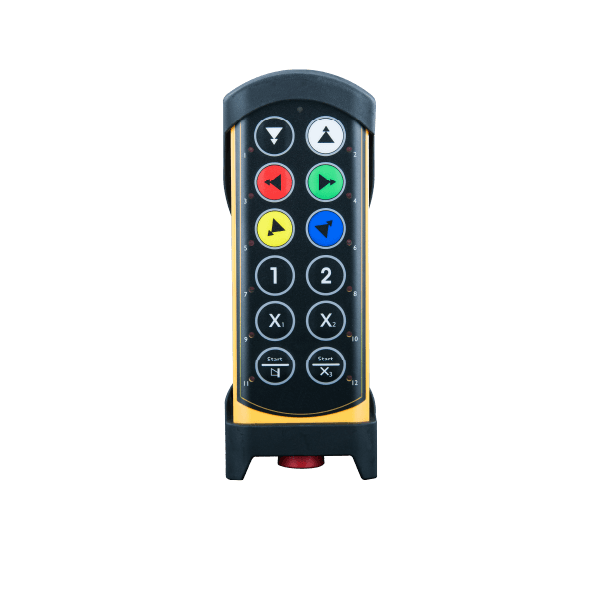
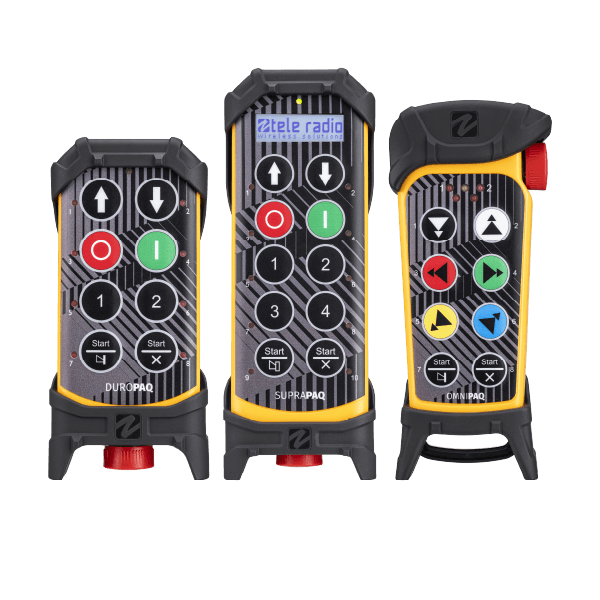
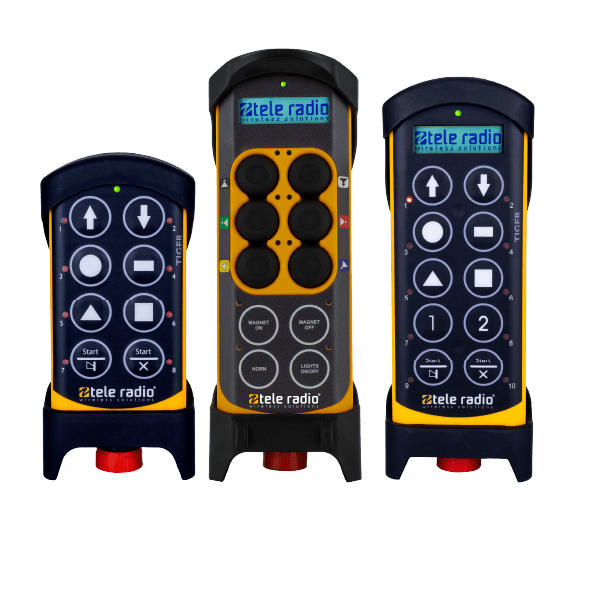
How our solutions comply
✓ Emergency Stop (E-Stop) Certification: Our system meets Category 3 (CAT3), Performance Level d (PLd), and Performance Level e (PLe) standards, ensuring the E-stop responds within 500 milliseconds (ms) to stop operations safely.
✓ Fail-Safe Operation: Our CAT3, PLd, and PLe certifications ensure the wireless control system is protected from interference by other devices, automatically shutting down the main contactor (head contactor) in a fail-safe manner if interference occurs.
✓ Safe Startup: No outputs are active on startup (except for safety-enhancing functions like work lights), as required by PLd and PLe certifications, preventing unintended operation.
✓ Double-Press Start: Our system requires a double-press to activate the controller, a safety feature mandated by the Machinery Directive to prevent accidental starts. This is standard in PLx-certified remotes and not separately tracked.
Need help navigating compliance?
Our team is here to guide you through system upgrades and ensure your tow truck operations stay safe, certified, and reliable. Contact Tele Radio Australia for expert support and compliant control systems.


 Tele Radio supports the world wide preservation of the Tiger with WWF.